When we talk about education and its importance, what we really want to know is how to instill in our students the knowledge that will make them better scholars and better people. How can we be sure that we send them out into life with the skills they really need to grow up successfully and happily? The International Baccalaureate Programme is more than ever dedicated to advancing international education that creates a better world.
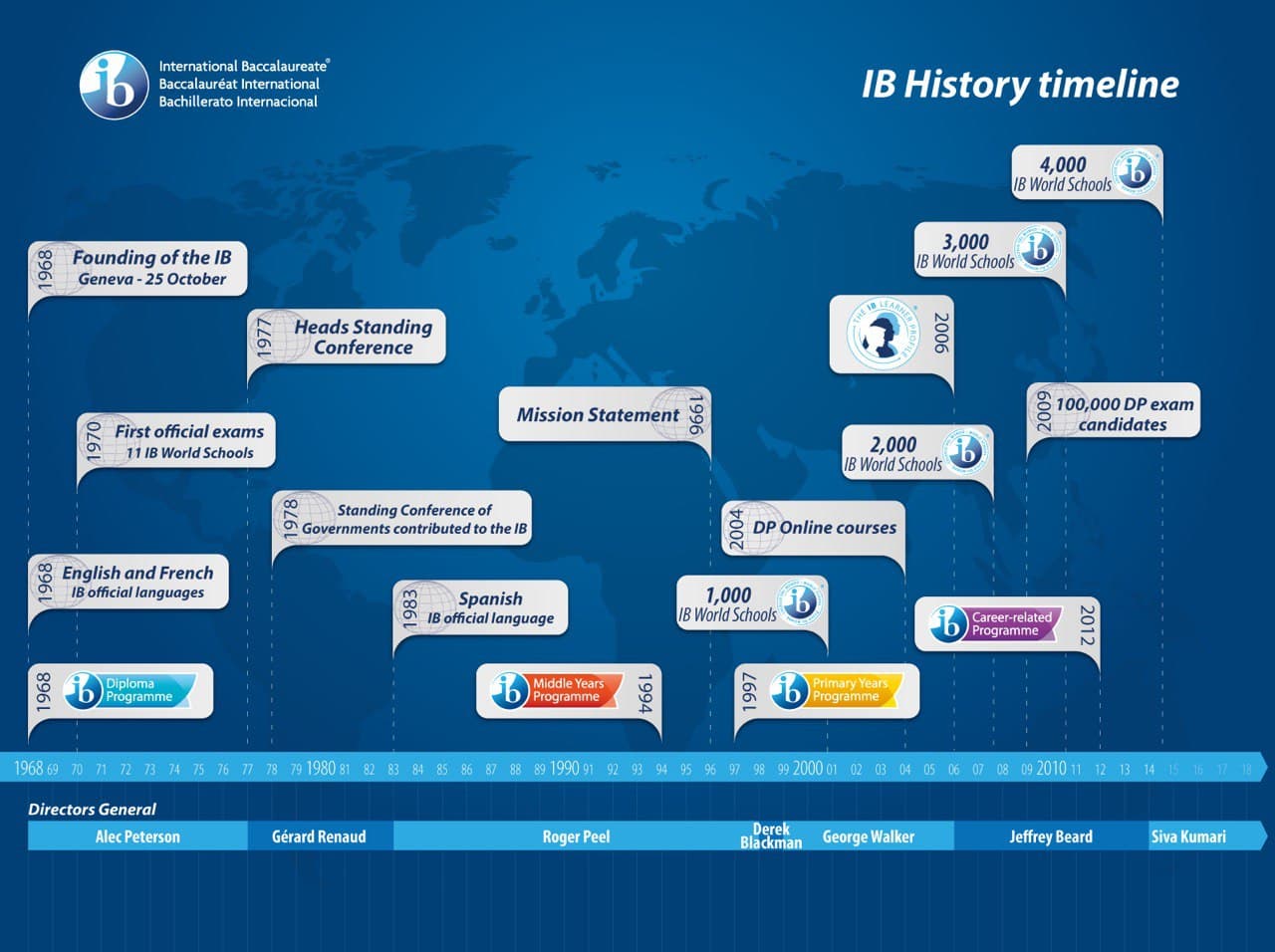
First IBO headquarters (International Baccalaureate Organization) was officially launched in Geneva in 1968, with the support of UNESCO, the International Baccalaureate Organization (IBO) is a non-profit foundation that does not belong to any particular country. The main goal of the organization was to create a common curriculum for all countries, allowing students to enter any educational institution in the world. Later, this program was renamed the Diploma Programme. In 1994, the Middle Years Programme was created, and in 1996, the Primary Years Programme. The final project of the IB was the Career-related Programme, offered in 2012. Studying in the International Baccalaureate (International baccalaureate, IB) encourages students to discuss global world issues, learn independently, think critically and approach problems creatively. It gives students a unique opportunity to enter almost any university in the world. Special programs are designed for children from 3 to 19 years old and include all stages of primary and secondary education.
Advantages of the program IB
- Foreign universities. Students with the IB diploma can enter many universities around the world directly. Among them are prestigious universities Ivy Leagues, MIT, Oxford, Sorbonne, Humboldt University of Berlin and many others. IB school graduates do not need to take any additional courses like other applicants.
- Teaching methods. The International Baccalaureate degree programs help students begin learning independently, develop critical thinking and research skills, and are taught in English, meaning students will be fluent in the language by the end of their studies.
- Interesting education. IB students interact with their teacher and classmates, have the opportunity to participate in various sections and extracurricular activities. The attentive attitude of the teacher to the student helps them feel like part of the family.
- Quality of education. According to IB research, International Baccalaureate students demonstrate better academic performance and greater critical thinking skills than students from other general education schools. Diploma and Professional Programme graduates are more successful in higher education than students from other schools, and are more likely to attend elite universities and graduate with honours.
- Objectivity of assessment. In order to assess students' work as objectively as possible, the IB programme has introduced a two-stage marking system. Students' work is marked not only by teachers in schools, but also by external examiners who use special marking guidelines developed by the IB.
- Scholarships. International universities often provide special scholarships and grants, as well as discounts for IB graduates.
- Examination courses English courses completed at IB schools are taken into account upon admission instead of IELTS/TOEFL. Another language at the advanced level (HL) can also be accepted by the university commission as a replacement for the language certificate.
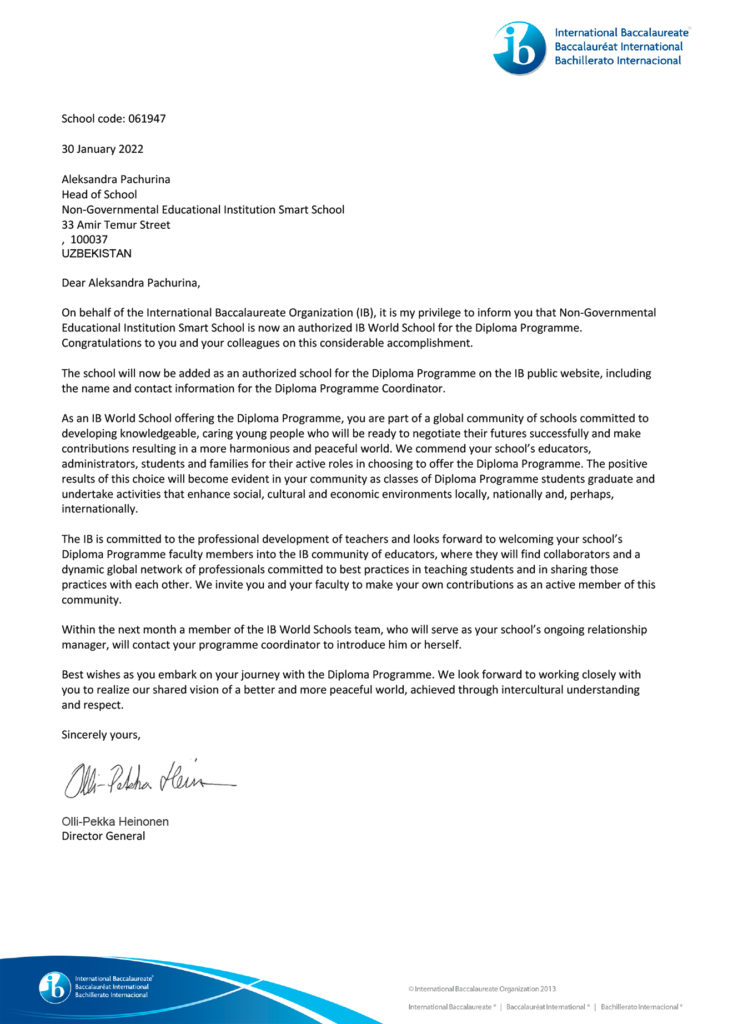
Our school is accredited by the IB DP program.
NGO "Smart School" is an authorized IB World School for the Diploma Program.
All IB International Schools share a common philosophy - a commitment to quality, well-rounded education that is truly relevant to all of our students.
Only schools authorised by the IB can offer any of the four academic programmes: the Primary Years Programme (PYP), the Middle Years Programme (MYP), the Senior Years Programme (DP) or the Career-focused Programme (CP).
For more information about the IB and its programs, visit http://www.ibo.org
Certificate of Accreditation
The International Baccalaureate Diploma Programme (IBDP) is a two-year degree programme aimed primarily at young people aged 16 to 19 in 140 countries worldwide. The programme provides an internationally recognised qualification for entry into higher education and is accepted by many universities worldwide. It was developed in the early to mid-1960s in Geneva, Switzerland, by a group of international educators.
The IBDP, administered by the International Baccalaureate (IB), is taught in schools in one of three languages: English, French or Spanish. IBDP students take examinations in six subjects, one from each subject group, and three core requirements. Students are assessed using both internal and external assessment, and courses conclude with a series of externally assessed examinations, usually consisting of two or three scheduled written tests. Internal assessment varies depending on the subject and may include oral presentations, practical work or written work.
In the UK, The Guardian newspaper claims that the IBDP is "more challenging and broader than three or four A-levels".
What is the International Baccalaureate Diploma Programme?
The Diploma Programme (DP) is a curriculum developed by the International Baccalaureate (IB) for students in the final two years of high school or sixth form at college. The DP is a rewarding and academically challenging programme of study that prepares students for success at university and for life beyond the classroom. It is designed to improve students' intellectual, social, emotional and physical well-being.
What is the CORE and how is it assessed?
The core of the program is Theory of Knowledge, Extended Essay, and CAS (Creativity, Activity, Service). Theory of Knowledge is a 100-hour course, delivered over 2 years, on critical thinking and exploration of the nature of knowledge.
How does this work?
DP students study six subjects (three at standard level and three at higher level) over two years and complete three additional requirements: Theory of Knowledge (TOK), an extended essay and at least 150 hours of creative, practical and service-oriented assignments (also known as CAS) outside the classroom. The subjects include: - Language Studies - Sciences - Arts - Mathematics - Individuals and Society - Language and Literature Studies In addition to these requirements, students must achieve a minimum of 24 points out of a possible 45 points in the final assessment, i.e. the external assessment and moderation by the IB, to receive the IB Diploma.
List of documents for applicants under the IBDP program
- statement
- photocopy of student ID card
- availability of a certificate (IELTS 6+, TOEFL 60-78, CEFR C1)
- successful completion of tests in mathematics
- photo 3x4 (4 pcs.)
- medical record
- a photocopy of the parents' passport.
- certificate from parents' place of work